I just listened once again to an interview online I'd heard in the past, from the radio program Open Source that's worth a listen:
http://stream.publicbroadcasting.net/ros/open_source_050927.mp3
It spends a lot of time talking with several seasoned combat artists--two marines and one civilian: Col. (Ret.) Avery Chenoweth, Steve Mumford, and then SSgt Michael Fay (who was in Iraq at the time) .
They really paint a fuller picture on what combat art is than what I could say. It's worth the time.
You can also look at some of the work of these artists on the Open Source website.
Saturday, April 21, 2007
Friday, April 20, 2007
A Civilian Combat Artist to See
This is an excellent video featuring a civilian combat artist, New York artist Steve Mumford, who has spent more than ten months in Iraq over the course of 5 trips, embedded with the US Army.
I've had a few email conversations with him in the past, and find him to be an artist who knows his combat art history as well as his combat art. I think he explains the role of the combat artist well in this clip.
You can find out more about him and his work on the web:
http://www.postmastersart.com/
http://www.artnet.com/magazine/features/baghdadjournal.asp
http://www.csmonitor.com/2005/1214/p14s02-alar.html
and:
http://abcnews.go.com/WNT/PersonOfWeek/story?id=339980&page=1
It's good to see an artist truly dedicated to authentic art-making-- so much so that he will risk life and limb to go to a war zone to create that art. He is dedicated to telling the story truthfully, and with a fresh artistic style.
I think you'll find that his work-- especially the ink washes-- has an immediacy and freshness that is invigorating.
Carry on, Steve!
Thursday, April 19, 2007
Role Models...
author's note: this blog entry originally posted in July of 2006. It has since been edited for form and content from its original posting, and re-posted here.
Back in July, I was researching a rather unpleasant subject (involving a controversial photo published in a major newspaper) During my research, I came across something I thought was uplifting and positive:
The comments section on one of the blogs included a great link to a site about Ernie Pyle, and his days as a WWII correspondent.
I also saw a photo on that site about Bill Mauldin of Willie and Joe fame, and it reminded me of his wonderful cartoons that inspired me as a young artist and history lover.
These two men, Pyle and Mauldin, really set the bar for all who take up pen (or brush!) to document war. They are truly role models that deserve our respect and emulation.
These men risked their lives (all of the journalists and correspondents in those days did). Some gave their lives. They all, however, lived their lives and careers fully and with intense national patriotism. And the fruit from their labors was real and sweet.
May America remember the real work of these authentic men-- and may the men and women of this generation take up the standard and carry it forward in truth, honesty and pride.
Responsibility in Art
I just got back this afternoon from an interview on NPR, at their main office in DC. It was a taped interview for the show, "On the Media" and should sometime soon .
UPDATE: the interview will air this weekend, but you can already hear the interview if you click on the link on their web site here).
Altogether, I think the interview went well-- during the interview, however, some of the statements I made in my earliest posts were referenced, seemingly with an eye to highlighting political controversy-- I have since edited those posts, and moved them to another blog, to hopefully eliminate any such controversy, as my goal in this weblog is not to be a political blogger, but to do what I stated in my first post:
"I will endeavor to show a realistic view of the war through the eyes of one on the ground, while also being truthful to the long, rich history of combat art and the art of picture-making itself."
In another part of the interview, some questions were raised as to the artistic guidelines for my work-- what I choose or don't choose to paint about, and why or why not I might paint about certain things. (For example, why I didn't paint a picture of the dead insurgent I saw on one patrol, and why I don't tend to show any negative images, etc...)
I explained in the interview that I believed all artists had a responsibility to be professional and responsible in what they produce, as well as to be faithful in accurately portraying Reality with their work.
Combat artists are not in the business of propaganda, nor do they have any political axe to grind. Rather, they are given the task of going to war and portraying that reality through traditional artistic media.
I think perhaps a lot of people are unaccustomed to what combat art is, and have certain presuppositions about Marine Corps Art and Marines in general. It also seems that some people believe that combat art isn't about truth or accuracy. The body of work in the Marine Combat Art Collection certainly gives no evidence for that assertion. (See other examples here).
And I hope that my answers in the interview, as well as my continuing body of work, will disabuse people of any false presuppositions they may have about combat art.
Friday, April 13, 2007
Another Work in Progress
The Corner Office
When I was in Iraq, drawing and painting, one of the things that continually fascinated me was the youth of the marines I saw, and also the working conditions these marines faced day-to-day-- those "obscene amenities" once mentioned... (I know it's cliche to say "they're just kids", but the older I get the younger 20 years old seems!)
At one outpost near Saqlawiyah, I met some marines from "G" Co of the 2nd Bn, 8th Marines, as they were on post guarding an intersection at their Outpost...
These marines had to sit in this guard shack, a little plywood creation on stilts (crude but ingenious) and watch for insurgents who would do them or the local citizenry harm. They were good-natured kids, and I talked to them and took pictures of them while they worked.
I also did a quick sketch of it while I was there, and cut it short due to a fear (i.e. rational concern!) of snipers. I had to do the scene in oil when I returned home, it was such an interesting place.
Here are the preliminary underpaintings/color block-ins of this piece, a Tryptich I call "The Corner Office" (I'll post more photos as the project progresses):


I'm painting them in what I call a Schmidian fashion, after the famous painter Richard Schmid, who has a way of simply and beautifully rendering detail in a painting. I don't know if these paintings will end up beautiful, but I hope the subject will at least be beautifully rendered!
The Not So Empty Canvas
I've been busy on several paintings lately (I'm currently working on nine canvases, in various states of finish!).
Here's series of photos of a large piece (60" x 30") I've recently begun. The photos will give you a look at how I am crafting the piece, to show an in-process view of one of my paintings.
There are many ways to begin and develop a painting, but in this case I'm trying to be as painterly as I can be, so the finished painting will not only stand as a representation of reality (here, a meeting between Civil Affairs Group and Recon Marines and Iraqi citizens near Korean Village) but also as a painting to enjoy.
Blocking In:
It starts with a gray toned canvas, and a succession of areas and colors placed roughly in. This first layer is called the underpainting, or Blocking In.
 The first area is the sky and background. You can see the toned canvas with basic shapes of the figures. Hopefully, this will show a good relationship between positive and negative shapes.
 The figures are then roughly blocked in, though not haphazardly-- it's important to me to maintain proper color and temperature, while establishing value relationships as well. If I can get it right now, then I will have less to adjust later, and the painting will also maintain a good "painterly-ness".
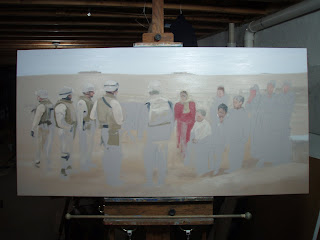 The figures take more shape...
 More and more of the Blocking-in comes together:

 Some details of the figures on the left:

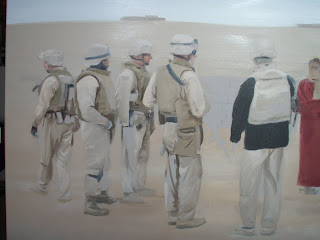
Some details of the figures on the right:


I'll keep you posted as the blocking in progresses, and I'll show the middle and end-game steps in the painting process, so you can see the whole thing from start to finish.
Here's series of photos of a large piece (60" x 30") I've recently begun. The photos will give you a look at how I am crafting the piece, to show an in-process view of one of my paintings.
There are many ways to begin and develop a painting, but in this case I'm trying to be as painterly as I can be, so the finished painting will not only stand as a representation of reality (here, a meeting between Civil Affairs Group and Recon Marines and Iraqi citizens near Korean Village) but also as a painting to enjoy.
Blocking In:
It starts with a gray toned canvas, and a succession of areas and colors placed roughly in. This first layer is called the underpainting, or Blocking In.
blocking in - Laying down the initial statement of a picture by a broad indication of line, color, and tone. After blocking in, artists typically develop their compositions from general to particular by ever-increasingly refining shapes, colors, textures, etc., until an artwork is finished. Also see abbozzo, sketch, and study.
underpainting - The layer or layers of color on a painting surface applied before the overpainting, or final coat. There are many types of underpainting. One type is an all-over tinting of a white ground. Another is a blocked out image in diluted oil paints that serves as a guide for the painter while developing the composition and color effects. Also see abbozzo, azurite, grisaille, pochade, and sinopia.
Here are the Step by Step photos (please pardon the poor quality-- I've got to get a better camera):
 The first area is the sky and background. You can see the toned canvas with basic shapes of the figures. Hopefully, this will show a good relationship between positive and negative shapes.
 The figures are then roughly blocked in, though not haphazardly-- it's important to me to maintain proper color and temperature, while establishing value relationships as well. If I can get it right now, then I will have less to adjust later, and the painting will also maintain a good "painterly-ness".
 The figures take more shape...
 More and more of the Blocking-in comes together:

 Some details of the figures on the left:


Some details of the figures on the right:


I'll keep you posted as the blocking in progresses, and I'll show the middle and end-game steps in the painting process, so you can see the whole thing from start to finish.
Sunday, March 18, 2007
The Empty Canvas
 "For sheer excitement you can keep movie premieres and roller-coasters. An empty white canvas waiting to be filled. That's the thing." --Pam Brown (b. 1928)
Recently, I received several new linen canvases from my bosses at the Museum.
I unwrapped them and stared at them, almost salivating. I have always wanted to paint on linen, and I’ve been dying to get started on larger works for the Combat Art Collection.
I have always loved an empty canvas. It’s so clean, perfect and unblemished—it is full of possibility, and begs to be filled, worked and tarried over, until it comes forth an object of worth and beauty.
The empty canvas has always been a bit of a metaphor (and cliché!) for life. The empty canvas, like life, is full of promise and mystery. It is a place for creation and bringing forth beauty. Quality lives, like quality canvases, are best filled by passionate and well-thought-out effort.
I have been working on these canvases for the last couple of weeks (images to come) and they will soon be filled with depictions of my experiences in Iraq. Yet that is not the only reason I as a combat artist went about Al AnbarProvince, sketching and taking photos & video --I went so that artworks will be created which stand, not only as a record of a marine’s experiences, but also as representations of deeper, timeless truths.


Friday, January 26, 2007
Out of Iraq!
 Hello, all
I am happy to report that I am safely back from Iraq (I went to see the elephant, and thank goodness he didn't see me)! Though I went to many places in Iraq--most of them not on the travel brochures-- I was spared from all dangers, and escaped wounding, combat, and major distress.
I left Iraq and arrived at Ali AL Salem airbase in Kuwait on 17 January 2007, stepping down onto the tarmac, a free bird off the Freedom Bird! (see the photo of my boots on the asphalt...)

After a gruelling experience involving the paperwork required to fly my weapon back with me out of Kuwait, I boarded a commercial aircraft on 20 January at the Kuwait Airport and flew across the sea. The flight lasted over fourteen hours, but the movies and the meal were good, so it was overall quite bearable.
I reported to Camp Pendleton the same day, 20 January (due to the dynamics of jet travel and changing timezones, 20 January lasted more than 30 hours for me!). At Camp Pendleton, I spent a few days checking out of the I Marine Expeditionary Force, the unit I was attached to on my deployment.
Then, after a gruelling experience involving the screening required to fly my weapon back with me out of the San Diego Airport, I flew back to Quantico on 24 January 2007. The flight had a short layover in Ft. Worth which broke up the long distance, so I didn't mind it, though I was longing to see my family.
After a third and final grueling experience involving my weapon (I won't go into details...), I began settling back in at home. Soon I will be back to work in the studio.
Utilizing all the sketches, photographs and video I collected during my deployment, I will create larger, museum-quality paintings and sculptures for the National Museum of the Marine Corps, and the Marine Corps Combat Art Collection.
I can't wait to get started...
Tuesday, January 09, 2007
Arrested in Iraq!

I'm safe and sound and back in the office where we're working, after an interesting event. I was given the truck here, and told I could go out and sketch ... I did so...
 The MPs drove up just as I was leaving, and asked me if I was taking photos, I said I was, and that it was part of my job, showed them my Letter of Instruction detailing my job description, etc... they called it in, spoke on the radio with their boss, and told me that though they didn't have a problem with it, I'd still have to come with them down to the station to explain it to the Watch Officer... I followed them in, explained it, showed my ID, papers, secutiry clearance ID, and they told me that I should always phone the MP station before drawing and photographing, and then they let me go.
 Wow, what a day, huh? I can now say I got arrested by the MPs in Iraq!
Sunday, January 07, 2007
Life at an Outpost
Hey, everyone-
Man is my deployment going by fast! As Mary Todd, a friend of mine, likes to say, "Time flies like an arrow-- fruit flies like a banana..."
I am back inside the proverbial wire, and preparing to go out again, and I thought I'd better post some more of the sketches I've done recently while out visiting the troops where they work and live.
Most of these drawings come from my recent time with the 2nd Battalion, 8th Marine Regiment. They are in graphite wash, and I did most of them from life (the loose ones are from life- I find that the line and wash is more "loosey-goosey" when drawn from life than when drawn from photos) There's a freshness that comes from sketching from life-for all of you artists out there, I highly recommend sketching from life as often as you can.
 The line drawing, "Post at OP Riviera" is really unfinished, and I have to plead artistic (and old fashioned) cowardice, as I was rushing to finish it, due to the very real threat of snipers(!) It's very hard to concentrate on a drawing when you're doing the "sniper dance!" I will complete it in watercolor, or in oil, when I get time, as it's really an interesting structure, visually.
 The sketch of the marine reading the newspaper is from a photo I took back in November, and is a value and figure study for a larger oil painting I plan to do back in the States. It is a scene with several marines 3rd Bn 2nd Marines at OP Chargers near Habbaniyah, starting their morning.
 The sketch of the "Humvee" is a value study, as well as a study of one of the many types of turrets there are out here on the vehicles... I don't usually like to draw equipment alone, as it's rather impersonal, but I was interested in the netting draped on the turret, and thought it'd be good practice to render it... It's not perfect drawing, yet I was satisfied with the product and the practice.


Subscribe to:
Posts (Atom)